June 29, 2026
Retirement Calculator with Changing Salary and Contributions
Learn how changing salary, raises, promotions, contribution rates, and multiple accounts create more realistic retirement projections.
Most retirement calculators ask for a few simple inputs: your current age, retirement age, current savings, expected return, and annual contribution.
That can be helpful, but it misses a major part of real life: your career probably won't stay the same forever.
Your income may increase. Your savings rate may change. You may get promoted, switch jobs, start contributing more later, or temporarily reduce contributions during expensive seasons of life. A retirement calculator that assumes one salary and one contribution rate for your entire career can make your projection feel too simple.
That is why a retirement calculator with changing salary and contributions can be more useful.
Why normal retirement calculators can feel limited
A traditional retirement calculator usually assumes your income and savings behavior stay mostly flat. For example, it might ask:
- How much do you currently make?
- What percentage do you save?
- When do you want to retire?
- What return do you expect?
But many people do not follow a straight-line career path.
Someone might start at $55,000 per year, move to $75,000 after a few years, reach $100,000 later, and increase their retirement contributions as their income grows. Another person might save aggressively early, reduce contributions while raising a family, then increase savings again later.
Those changes can make a big difference.
Career stages matter
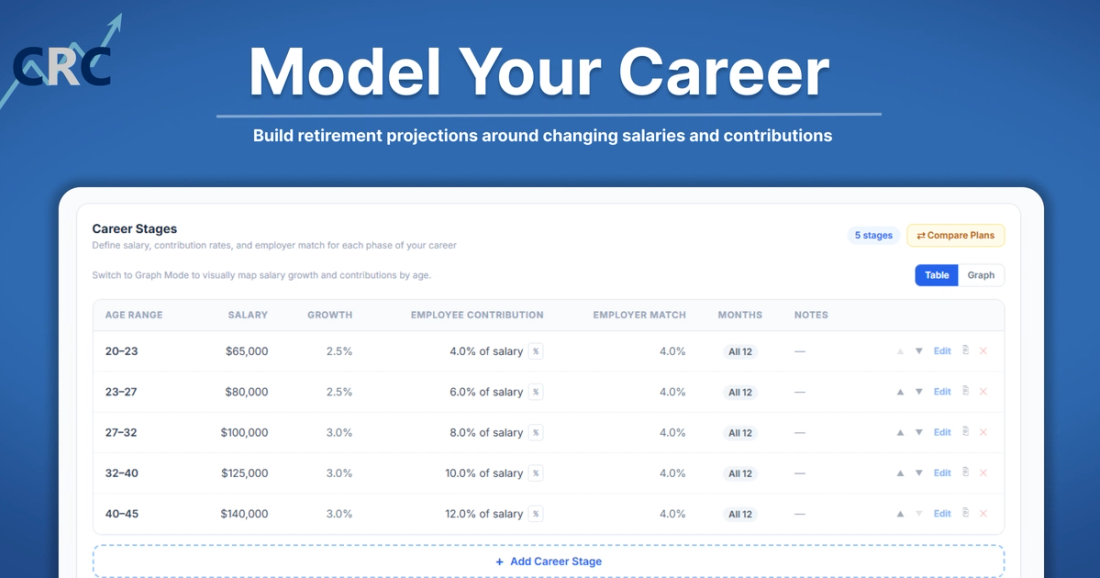
Instead of using one salary forever, it can be helpful to break your working life into career stages.
For example:
- Age 22–27: early career salary and lower contributions
- Age 28–35: higher salary after promotions
- Age 36–45: peak earning years and higher retirement contributions
- Age 46–55: final accumulation years before retirement
Each stage can have a different salary, contribution rate, employer match, and growth assumption.
This makes the projection feel closer to how real careers actually work.
Changing contributions can change the result
A small change in contribution rate can have a large long-term impact.
For example, saving 8% of income early in your career and later increasing to 15% may create a very different retirement outcome than assuming the same contribution rate forever.
This is especially important for people who expect their income to grow. A contribution rate that feels difficult at age 22 may become much more realistic later after raises, promotions, or debt payoff.
Multiple accounts can also matter
Many people do not have just one retirement account.
They might have:
- A 401(k)
- A Roth IRA
- A taxable brokerage account
- An old rollover IRA
- A spouse’s retirement account
Looking at only one account may leave out part of the picture. A more complete retirement projection can be easier to understand when multiple accounts are included together.
A better way to model your career path
The Career Retirement Calculator was built for people who want to model changing income and savings over time.
Instead of assuming your career is flat, you can create different career stages, adjust contribution rates, compare scenarios, and estimate how your retirement picture may change as your career grows.
It is not financial advice, and it does not replace a professional plan. But it can help you see how raises, promotions, contribution changes, and multiple accounts may affect your long-term retirement projection.
Try the calculator
If you want to model your own career path, try the Career Retirement Calculator.
You can estimate your retirement outcome based on changing salary, changing contributions, multiple accounts, employer match, and different retirement assumptions.